The 2027 Santa Barbara County High School Architectural Design Competition will be held on Tuesday, March 2nd at Santa Barbara City College and Allan Hancock College. Twelve finalists will compete in a Juried Review on March 6th at Elverhoj Museum in Solvang.
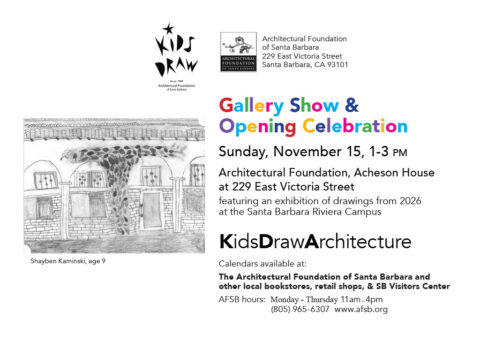
KDA Gallery Show & Opening Celebration
Sunday, November 15, 2026, 1-3 p.m. at the Acheson House Gallery. Featuring an exhibition of drawings from 2026 sketch session at Santa Barbara Riviera Campus.
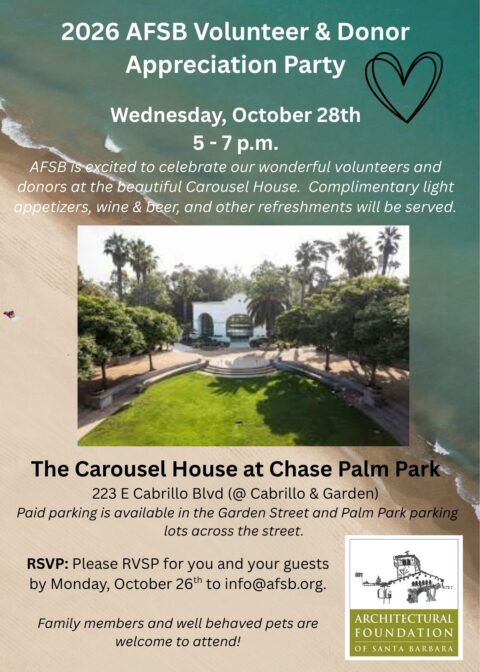
Continue readingAFSB 2026 Volunteer & Donor Appreciation Party!
Wednesday, October 28, 2026, 5 – 7 p.m., The Carousel House at Chase Palm Park. Attention all AFSB Volunteers & Donors! Please join us for a party in your honor. Complimentary refreshments will be served. Partners, family members and well behaved pets are welcome to attend! Please RSVP to info@afsb.org by October 26th.
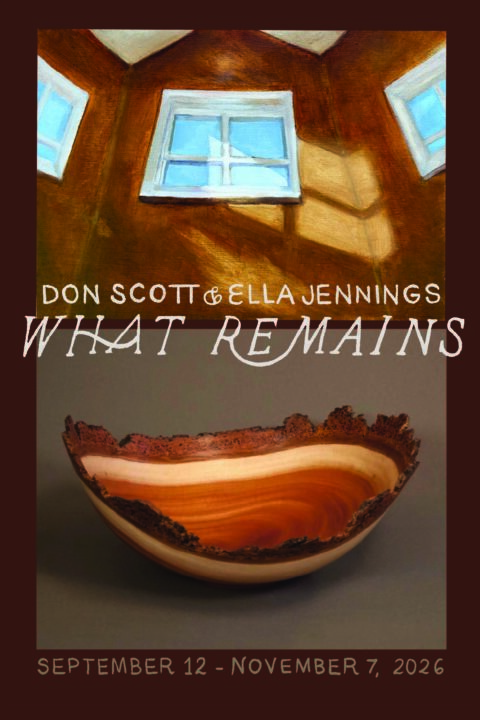
2026 Fall Exhibition: “What Remains” by Don Scott and Ella Jennings
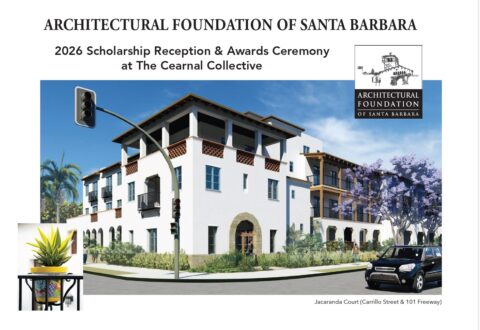
2026 Scholarship Reception & Awards Ceremony
June 16, 2026, 5:30 – 7:30 p.m. at The Cearnal Collective, 521 1/2 State Street (Second Floor), Santa Barbara.
This year we are awarding over $50,000 to 14 college students majoring in architecture or a related field. Join us as we celebrate their accomplishments. Tickets are $40 and available until June 11th. Click here.
THANK YOU TO OUR 2026 SCHOLARSHIP RECEPTION SPONSORS!
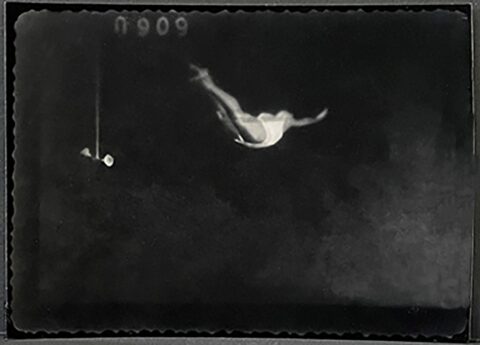
Summer Exhibition: “How Forever Works” by Jacqueline Woods, June 13 – August 15, 2026
The Architectural Foundation of Santa Barbara is pleased to announce the upcoming exhibition, How Forever Works, featuring photographic assemblages and camera-less works by Jacqueline Woods. An opening reception will be held on Saturday, June 13th from 2 to 4 p.m. at the Architectural Foundation’s Art Gallery (229 East Victoria Street, Santa Barbara). All are welcome.
Over the past four decades, Jacqueline Woods has developed a deeply reflective photographic practice exploring memory, perception, and the emotional resonance of found imagery. Working with small, physically aged photographs, worn and marked by time, she preserves their materiality while reconfiguring them into new forms.
“Smitten with these small objects, they have found their way into my life and my work… I keep a small stack of snapshots on a table next to my bed and frequent them in the daily defeat and elation of life…They are small slices of the rhythm and scope of life that reassure me that I am not alone in my experience and remind me that I am just as human as all those before me.”
Art critic Leah Ollman observed in a 2019 Los Angeles Times review, that Woods’ assemblages render the “personal as well as cultural loss” embedded in the shift from analog to digital photography.
In addition to her sustained engagement with traditional and vernacular photography, Woods has created works made without a camera or lens, using only paper, chemistry, and light—expanding the material and conceptual boundaries of the photographic medium.
Her work has been widely exhibited across the United States and internationally, tracing an evolving dialogue between personal history and collective experience.
May 28: Betsy J. Green – Discover Your Home’s History
Spring 2026 Lecture Series
Register for this event here. (Suggested donation $20).
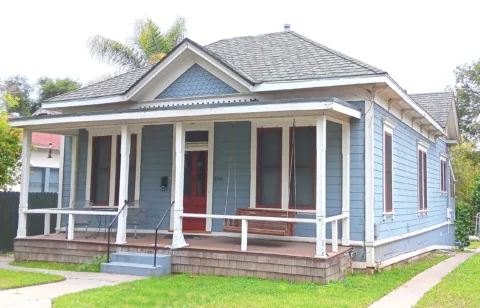
Being keenly aware of Santa Barbara’s built environment, especially the unique expression of each structure, is like unraveling a mysterious treasure hunt or jigsaw puzzle. Santa Barbara’s story is in large part told by uncovering the fascinating details of each structure and home that forms the city’s neighborhoods and overall character. Knowing your home’s history can even help attract prospective buyers and make your house stand out.
From reviewing old phonebooks, maps and building permits, to exploring genealogy websites, local historian, Betsy Green, will share “tips and tricks” for becoming your own house detective.
“There’s more and more information available online all the time – it’s a great time to be a home history hunter!” says Betsy.
Audience members are invited to bring questions about their home for Betsy to tackle in real time. Betsy will also share links to websites with useful information.
Betsy J. Green is a writer, local history aficionado, and author of the Great House Detective column for the Santa Barbara Independent.
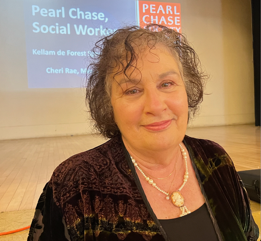
May 21: Cheri Rae – Santa Barbara’s 1960s Highrise Battle
Spring 2026 Lecture Series
Register for this event here. (Suggested donation $20).
What would Pearl Chase do now?
Please join us for a lively discussion about how balanced housing development was achieved in the 1960s and can inspire ways to move forward today in a Santa Barbara way.
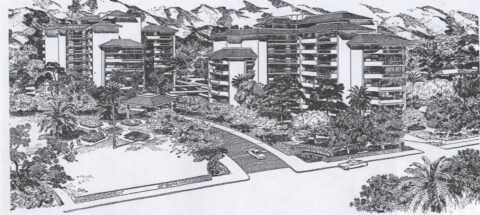
Back in the late 1960s, a 9-story 107-foot, two-tower condominium project along the El Mirasol block was proposed – and approved by Santa Barbara City Council – that would have changed Santa Barbara forever.
Thankfully, Pearl Chase was the leader of the Santa Barbara community activists who organized, raised funds, and successfully sued the City to prevent the outsized proposal.
The positive impact of that grassroots campaign led to a ballot measure that instituted height limits in Santa Barbara, and the site for the proposed towers became Alice Keck Park Memorial Garden, a lush garden with walking paths, benches, gazebo and pond, often referred to as the “crown jewel” of Santa Barbara’s city parks.
That was what Pearl did then to “Save Our City.”
But what would Pearl do now? And how do we follow in her footsteps?
Today, we are faced with similar issues of overdevelopment and can learn from the experience of the past. Recently enacted California housing laws streamline development by limiting local discretion, reducing community input, and enabling taller, denser projects near transit. By limiting local control, these measures are enabling developers to propose out-of-scale projects (in areas not designated for the scale), which is causing great community concern.
Cheri Rae will discuss the 1960s era Save Our City community initiative “to keep Santa Barbara Santa Barbara,” followed by an audience Q&A and refreshments on the patio.
Cheri Rae is an ardent civic activist, award-winning columnist, and author of more than 300 articles and commentaries about Santa Barbara. “Channeling her inner Pearl,” Cheri has led efforts to preserve the city’s Bungalow Haven Neighborhood, historic buildings and trees. She is the author of the biography, “A String of Pearls: Pearl Chase of Santa Barbara.”
April 19: 2026 KDA Sketch Session
2026 Spring Exhibition – PINHOLE NOIR by Lindsay Skutch
Spring Exhibition: PINHOLE NOIR by Lindsay Skutch
March 28 – May 30, 2026, at the Architectural Foundation Gallery
Opening Reception: Saturday, March 28th, 2 – 4 p.m.
Artist Talk: Saturday, April 25th, 2 – 3 p.m.
The Architectural Foundation of Santa Barbara is pleased to announce the opening of PINHOLE NOIR, an exhibition of recent pinhole camera photographs by Lindsay Skutch.
An opening reception will be held at the Architectural Foundation of Santa Barbara on Saturday, March 28, from 2 p.m. to 4 p.m. Skutch will present an Artist Talk in the gallery on Saturday, April 25, from 2 p.m. to 3 p.m.
Lindsay Skutch’s striking black & white photographs of familiar sites and sights in Southern California are taken with pinhole cameras she constructs using Sanka coffee cans, cardboard CBD containers, and Christmas cookie tins. The photographs have an eerie, outside of time feeling—like buried memories or dimly remembered dreams.
Pinhole cameras are a form of camera obscura (Latin for dark chamber)—a room or box with a small opening that allows light to pass through a tiny aperture, or pinhole, and project an inverted image of what is outside onto photographic paper on the opposite surface inside.
The exposure varies depending on location, sun direction and subject matter. The paper is processed in a darkroom, and it becomes the negative. Skutch prints all her photographs from cameras she makes and the negatives she processes.
The camera obscura/pinhole camera technique has been used since the 16th century by artists like Leonardo da Vinci; also, as a way of observing eclipses without looking directly at the sun and damaging the eyes.
Lindsay Skutch grew up in Greenwich, Conn. She was 13 years old when her father built her a dark room and she discovered that photography was her voice. She attended Brooks Institute of Photography in Santa Barbara, Calif.
After a successful, 38-year career in Los Angeles and New York producing global commercials with directors John Frankenheimer, Sidney Pollock, Alfonso Cuaron, and Kathryn Bigelow, Skutch now revels in the chance element involved in making pinhole photographs:
“You have no idea if the negative will turn out or what the image is truly going to look like. There is no viewfinder and no way of knowing if the tin can is even pointing at what you want it to.”
She credits Marian Roth of Provincetown, Mass. for teaching her the basics of this art form. Roth once said to her, “I make photographs, I don’t take photographs.”
The Architectural Foundation of Santa Barbara (AFSB) seeks to promote quality in architecture, art, and design by fostering an understanding of excellence in the urban environment. The AFSB offers diverse programs serving Santa Barbara County that provide educational opportunities for the community with participation from local architects and design professionals. Learn more at afsb.org.