Resources for our Community
Resource list brought to you by our AFSB Board of Directors. We hope it brings joy, knowledge or simply comfort.
Architecture:
Podcasts:
Arts/Travel:
Santa Barbara:
A Note From Board President on COVID-19’s Impact to AFSB
A Letter From Our Board President, Selinda Tuttle
Dear AFSB Community,
I’d like to start by thanking you for taking a moment to read this note. I think we’re all struggling to find the right thing to say right now, AFSB is no exception. During the unprecedented health crisis of COVID-19, AFSB has been temporarily closed and events indefinitely paused or delayed. But in chaos, there is an opportunity. Above all, the mission of AFSB is to build community.
Historically, we have done so through social gatherings and public events. Now we must find new ways to connect, engage, and support each other as we seek outlets that will fortify us in our time of need. I invite all our members, sponsors, subscribers, and supporters to stay engaged with AFSB as we explore different venues and platforms to build and strengthen our community.
After some time to adjust and reflect on our new reality, we are ready to move forward and work on how to best serve you, our AFSB community. The first program to be affected by cancellations and quarantine directives was our annual High School Design Competition. In the middle of their weeklong event, they adjusted and changed course without almost missing a beat, in support of our mission of education. And that is the spirit of perseverance we are adopting.
KDA and our Art Gallery were the next to be affected. KDA is currently finalizing a “KDA From Home” version to spark your kids’ creativity while home. For our current art gallery exhibition, “Meandering the Edges” by Nathan Huff, there are more photos and videos on our Instagram and on Nathan Huff’s website. Stay tuned for an interview by Board Member and Art Gallery Chair, Bay Hallowell, with Nathan to be posted on our website. Following this email will be a recap of this year’s High School Design Competition.
Thank you to all who support AFSB. On behalf of the entire AFSB Board of Directors, please stay safe and well. Together we will come through this. We look forward to celebrating with you in person again soon.
Kind Regards,

Selinda Tuttle, Associate AIA
Board President
Architectural Foundation of Santa Barbara
Learn. Experience. Give.
The Dark and Cryptic in Indiana
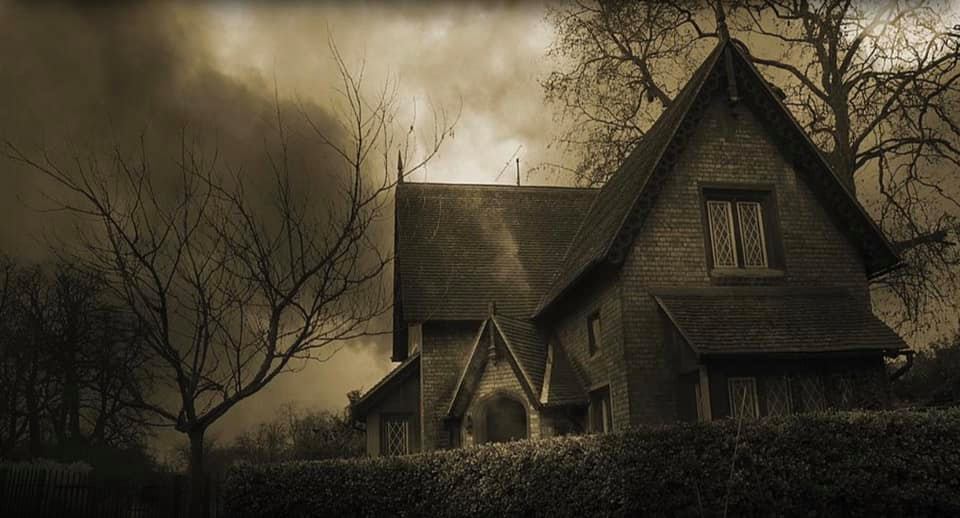
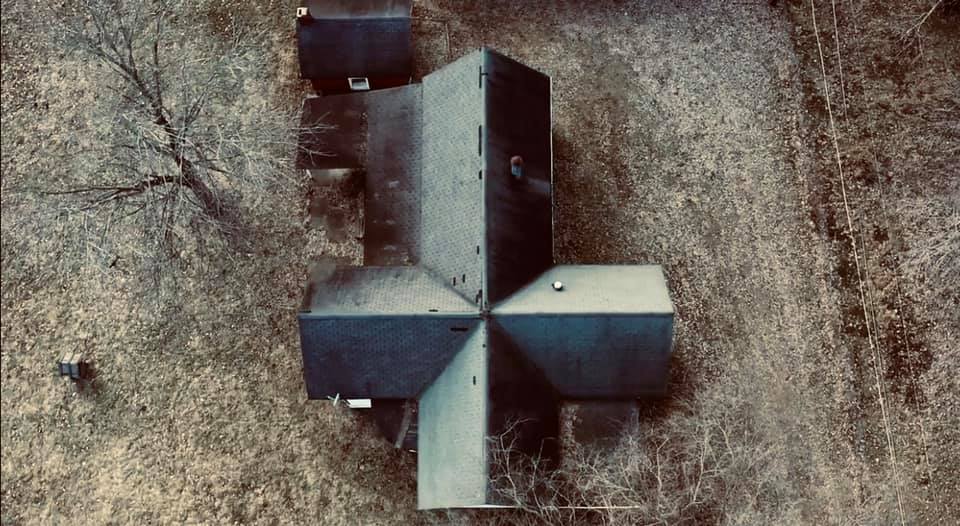
Constructed in the 1800s this phantom-rich house was built in the shape of a cross that faces east. That in itself is strange, but there is nothing else that is common to this house declared to be one of the “notoriously haunted properties in America.” The house sits on a crossroads and has a list of ghastly deaths that have occurred within its walls.
The home and land, located at 132 S Union Street in Cuyuga, Indiana is documented to have a strong Native American connection. There was a major battle very near where the house sits today. To add to its mystery, there are ancient burial sites around the area and two rivers converge in the tiny town. A strange book was found buried beneath the old floor that deals in Necromancy and other occult practices. Could all these factors contribute to the intensity of haunting in this property? Many believe it does!
The Dog Suicide Bridge of Scotland
This world holds thousands of alluring places filled with mysteries that attract people from everywhere. But there are a few that are born to lure people to a sinister fate. Many believe it to be a curse, many think it’s bad luck but those places keep continue the destinies. And “The Dog Suicide Bridge of Scotland” is significantly one of them.
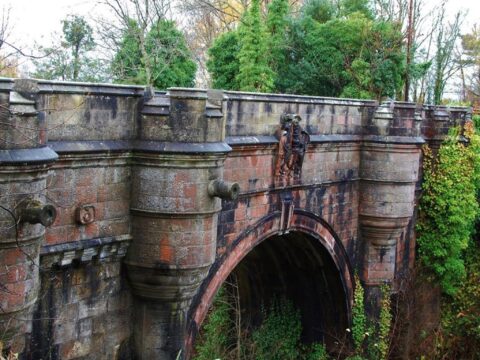
Near the village of Milton in Dumbarton, Scotland, there exists a bridge called the Overtoun Bridge that, for some reason, has been attracting suicidal dogs. That’s why this Gothic stone structure on the approach road to Overtoun House has infamously earned its name “The Dog Suicide Bridge.”
Lord Overtoun had inherited Overtoun House and the estate in 1891. He purchased the neighbouring Garshake estate to the west of his lands in 1892. To ease access to the Overtoun Mansion and the adjacent property, Lord Overtoun decided to build the Overtoun Bridge.
The bridge was designed by the renowned civil engineer and landscape architect H. E. Milner. It was constructed using rough-faced ashlar and was completed in June 1895.
To this day, more than six hundred dogs have jumped over the edge at the Overtoun Bridge, falling on the rocks 50 feet below to their deaths. To make things stranger, there are reports of dogs who survived the accidents, only to return to the bridge for a second attempt.
“The Scottish Society for the Prevention of Cruelty to Animals” had sent representatives to investigate the matter. But after getting on the bridge, one of them suddenly became willing to jump in there. They were totally baffled by the cause of the strange behaviour and they immediately had to close their investigation.
The canine psychologist Dr. David Sands examined the sight, smell and sound factors at the Suicide Bridge location. He concluded all these strange phenomena by saying that – although it was not a definitive answer – the potent odour from male mink urine was possibly luring dogs to their horrible deaths.
However, a local hunter, John Joyce, who has lived in the area for 50 years, had said “there is no mink around here. I can tell you that with absolute certainty.
A local behaviourist named Stan Rawlinson drew another possible cause behind the strange Suicide Bridge incidents. He said that dogs are colour blind and perceptual problems relating to this may cause them to accidentally run off the bridge.
.
From the beginning, the paranormal researchers from all around the world have been fascinated with the strange suicide phenomena of the Overtoun Bridge. According to them, the canine deaths have prompted claims of paranormal activity at the bridge site. Many even claim to witness ghosts or other supernatural beings within the bridge premises.
Southern U.S Folklore and the Bell Witch Haunting
The Bell Witch or Bell Witch Haunting is a legend from Southern United States folklore, centered on the 19th-century Bell family of northwest Robertson County, Tennessee. John Bell Sr., who made his living as a farmer, resided with his family along the Red River in an area currently near the town of Adams. According to legend, from 1817-1821, his family and the local area came under attack by a mostly invisible entity that was able to speak, affect the physical environment, and shapeshift. Some accounts record the spirit also to have been clairvoyant and capable of crossing long distances with superhuman speed (and/or of being in more than one place at a time).
In 1894, newspaper editor Martin V. Ingram published his Authenticated History of the Bell Witch. The book is widely regarded as the first full-length record of the legend and a primary source for subsequent treatments. The individuals recorded in the work were known historical personalities. In modern times, some skeptics have regarded Ingram’s efforts as a work of historical fiction or fraud. Other researchers consider Ingram’s work a nascent folklore study and an accurate reflection of belief in the region during the 19th century.
While not a fundamental element of the original recorded legend, the Bell Witch Cave in the 20th century became a source of continuing interest, belief, and generation of lore. Contemporary artistic interpretations such as in film and music have expanded the reach of the legend beyond the regional confines of the Southern United States.
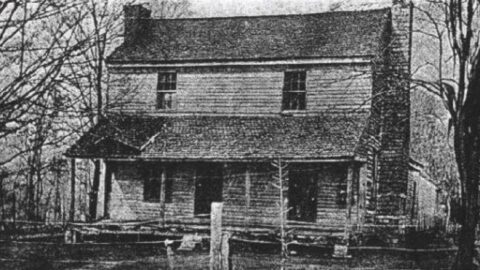
An artist’s sketching of the Bell home, originally published in 1894 (shown below). In his book An Authenticated History of the Bell Witch, author Martin Van Buren Ingram published that the poltergeist’s name was Kate, after the entity claimed at one point to be “Old Kate Batts’ witch,” and continued to respond favorably to the name. The physical activity centered on the Bells’ youngest daughter, Betsy, and her father, and ‘Kate’ expressed particular displeasure when Betsy became engaged to a local named Joshua Gardner.
The haunting began sometime in 1817 when John Bell witnessed the apparition of a strange creature resembling a dog. Bell fired at the animal but it disappeared. John’s son Drew Bell approached an unknown bird perched on a fence that flew off and was of “extraordinary size.” The daughter Betsy observed a girl in green dress swinging from the limb of an oak tree. Dean, a slave of the Bell family, reported being followed by a large black dog on evenings he visited his wife. Activity moved to the Bell household with knocking heard along the door and walls. The family heard sounds of gnawing on the beds, invisible dogs fighting, and chains along the floor. About this time John Bell began experiencing paralysis in his mouth. The phenomena grew in intensity as sheets were pulled from beds when the children slept. Soon the entity pulled hair and scratched the children with particular emphasis on Betsy who was slapped, pinched and stuck with pins.
The Bells turned to a family friend James Johnston for help. After retiring for the evening at the Bell home, Johnston was awakened that night by the same phenomena. That morning he told John Bell it was a “spirit, just like in the Bible.” Soon word of the haunting spread with some traveling great distances to see the witch. The apparition began to speak out loud and was asked, “Who are you and what do you want?” and the voice answered feebly, “I am a spirit; I was once very happy but have been disturbed.” The spirit offered diverse explanations of why it had appeared, tying its origin to the disturbance of a Native American burial mound located on the property, and sent Drew Bell and Bennett Porter on an unproductive search for buried treasure. With the emergence of full conversations, the spirit repeated word for word two sermons given 13 miles apart at the same time. The entity was well acquainted with Biblical text and appeared to enjoy religious arguments. As another amusement, the witch shared gossip about activities in other households, and at times appeared to leave for brief moments to visit homes after an inquiry.
John Johnston, a son of James, devised a test for the witch, something no one outside his family would know, asking the entity what his Dutch step-grandmother in North Carolina would say to the slaves if she thought they did something wrong. The witch replied with his grandmother’s accent, “Hut tut, what has happened now?” In another account, an Englishman stopped to visit and offered to investigate. On remarking on his family overseas, the witch suddenly began to mimic his English parents. Again at early morning, the witch woke him to voices of his parents worried as they had heard his voice as well. The Englishman quickly left that morning and later wrote to the Bell family that the entity had visited his family in England. He apologized for his skepticism.
At times, the spirit displayed a form of kindness, especially towards Lucy, John Bell’s wife, “the most perfect woman to walk to earth.” The witch would give Lucy fresh fruit and sing hymns to her, and showed John Bell Jr. a measure of respect.
Referring to John Bell Sr. as “Old Jack,” the witch claimed she intended to kill him and signaled this intention through curses, threats and afflictions. The story climaxes with the Bell patriarch being poisoned by the witch. Afterward the entity interrupted the mourners by singing drinking songs. In 1821, as a result of the witch’s entreatment, Betsy Bell called off her engagement to Joshua Gardner. Subsequently, the entity told the family it was going to leave, but return in seven years in 1828. The witch returned on time to Lucy and her sons Richard and Joel with similar activities as before, but they chose not to encourage it, and the witch appeared to leave again.
Several accounts say that during his military career, Andrew Jackson was intrigued with the story and his men were frightened away after traveling to investigate. In an independent oral tradition recorded in the vicinity of Panola County, Mississippi, the witch was the ghost of an unpleasant overseer John Bell murdered in North Carolina. In this tradition, the spirit falls in love with the central character ‘Mary’, leading to her death.
In the manuscript attributed to Richard Williams Bell, he wrote that the spirit remained a mystery.
“Whether it was witchery, such as afflicted people in past centuries and the darker ages, whether some gifted fiend of hellish nature, practicing sorcery for selfish enjoyment, or some more modern science akin to that of mesmerism, or some hobgoblin native to the wilds of the country, or a disembodied soul shut out from heaven, or an evil spirit like those Paul drove out of the man into the swine, setting them mad; or a demon let loose from hell, I am unable to decide; nor has any one yet divined its nature or cause for appearing, and I trust this description of the monster in all forms and shapes, and of many tongues, will lead experts who may come with a wiser generation, to a correct conclusion and satisfactory explanation.”
— Williams Bell, An Authenticated History of the Bell Witch
Lingering and Sentimental Spirits in The Merchant House
A house preserved from the 19th century, ghosts included.
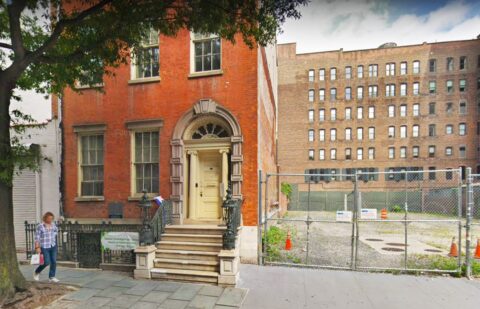
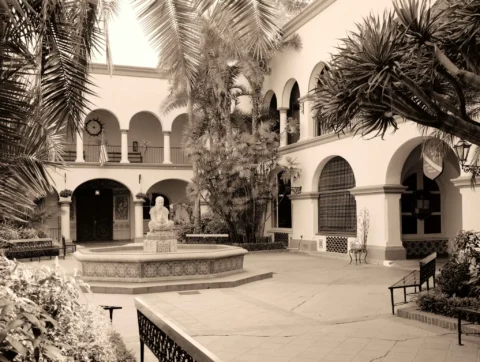
The Merchant House, a historic row house turned museum, stands at 29 East 4th Street and today is considered one of the best preserved federal buildings in New York City. But long before tourists walked through its Greek Revival style halls, the house was occupied by the Tredwells, a wealthy Manhattan family. The five-story brick structure was purchased by Seabury Tredwell for $18,000 in 1835. During the late 1830’s, Mr. Tredwell moved his wife and children into the Merchant House and prepared for the birth of their eighth child, the only one to be born at their new home – and the only one to never leave.
As the legend goes, the youngest Tredwell, Gertrude, grew up surrounded by all the modern luxuries, ornate décor and beautiful, lavish furnishings money could buy, many still on display at the Museum. In her twenties, Gertrude fell madly in love with a Catholic doctor named Lewis Walton. However, the Tredwells were strict, God-fearing Protestants and Seabury immediately quashed the affair, separating the couple forever and breaking poor Gertrude’s heart. While her parents died shortly thereafter, Gertrude promised to never disobey her father’s wishes, and remained unwed to any mortal soul.
In 1909, at sixty-nine years old, Gertrude was the last remaining Tredwell and the House’s only occupant. She was largely considered a recluse and a spinster, wholly and faithfully committed to keeping her home in the same exact manner as it was kept during her childhood. She proceeded through life alone, barren of friends, family or romance, the house her only partner. When she finally died in 1933, Gertrude left the Merchant House in pristine period condition, making the project a quick transition from living quarters to public museum.
According to The Big Book of New York Ghost Stories, Gertrude’s spirit has been glimpsed many times lingering about the old mansion. There are countless reports of a Gertrude’s ghastly figure gliding up the stairs and through the halls, refusing to abandon her perfect home even years after her demise. Clear notes coming from the House’s broken piano have allegedly been heard streaming from the parlor window and onto the street for passersby to enjoy, even when the museum was locked and empty. Teacups have been known to uproot themselves from the shelves and scatter about the kitchen and dining room. And a cool breeze emanates throughout the upstairs room where Gertrude last laid her head.
The Schenck Mansion Lingering Residents
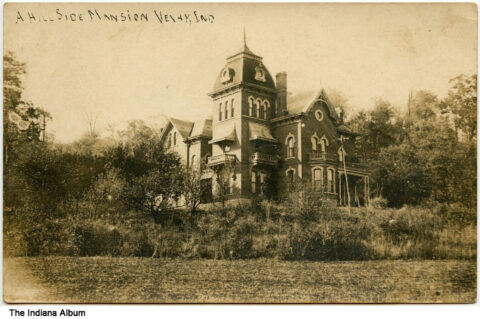
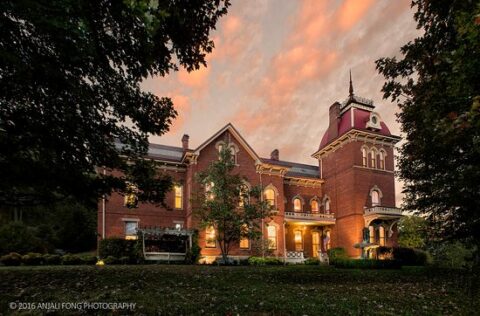
One of Indiana’s most outstanding examples of the Second Empire style, the Schenck Mansion is individually listed in the National Register of Historic Places. “The house on the hill” is located in the beautiful Ohio River town of Vevay. Built by Benjamin Franklin Schenck, son of a fabulously wealthy “hay king” of the steamboat era, this palatial mansion was the marvel of its time with its four storied tower, thirty-five rooms from basement to attic and five baths. This house was built in 1874 at a total cost of $67,000. Its four-story tower with a mansard roof measuring 74 feet tall, bay windows, high ceilings and spacious rooms are characteristic of the architecture of the time. The architect of record was George P. Humphries of Cincinnati. Amazingly, the original architect’s plans have remained with the mansion.
In November 1874, on account of failing health, he and his family spent the winter and spring in Florida. He was able to spend the next two summers in his newly finished mansion in Vevay, but returned to Jacksonville, Florida where he died in April of 1877 at the age of 42. Mr. Schenck died before his palatial home was finished. Mrs. Celestine Schenck lived in the mansion intermittently until her death in December 1885. A ghostly lady in white Victorian dress haunts the second floor. She is said to walk the hallways, taking no notice of anyone around her. Guests also have reported hearing voices, footsteps, and something moving in their rooms at night.
A House Alive With Whispers
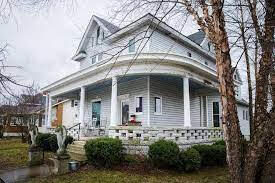
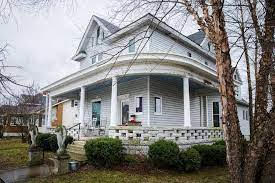
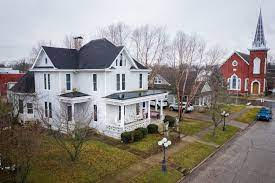
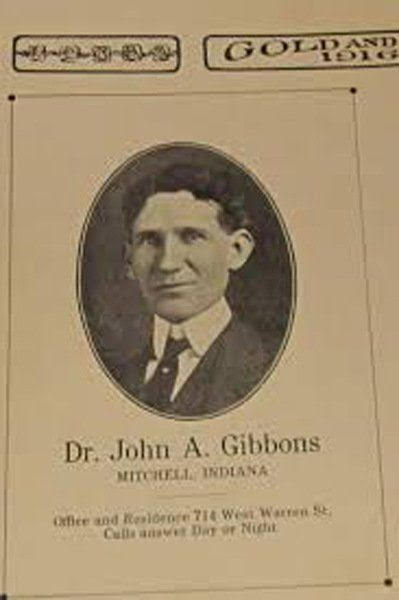
Whispers Estate was built in 1894, a Victorian mansion located at 714 W Warren St in Mitchell, Indiana, has been proclaimed the most haunted house in the US. In 1899, Dr John and Jessie Gibbons purchased the house from the original owners, Dr George and Sarah White. Dr Gibbons was a prominent doctor in town, having his office in the 1st floor rooms in the house.
On its official website, http://
Old World Charm and Ghosts in the Schenck Mansion, Indiana
One of Indiana’s most outstanding examples of the Second Empire style, the Schenck Mansion is individually listed in the National Register of Historic Places. “The house on the hill” is located in the beautiful Ohio River town of Vevay. Built by Benjamin Franklin Schenck, son of a fabulously wealthy “hay king” of the steamboat era, this palatial mansion was the marvel of its time with its four storied tower, thirty-five rooms from basement to attic and five baths. This house was built in 1874 at a total cost of $67,000. Its towers, bay windows, high ceilings and spacious rooms are characteristic of the architecture of the time. The architect of record was George P. Humphries of Cincinnati. Amazingly, the original architect’s plans have remained with the mansion.
In November 1874, on account of failing health, he and his family spent the winter and spring in Florida. He was able to spend the next two summers in his newly finished mansion in Vevay, but returned to Jacksonville, Florida where he died in April of 1877 at the age of 42. Mr. Schenck died before his palatial home was finished. Mrs. Celestine Schenck lived in the mansion intermittently until her death in December 1885.
A ghostly lady in white Victorian dress haunts the second floor. She is said to walk the hallways, taking no notice of anyone around her. Guests also have reported hearing voices, footsteps, and something moving in their rooms at night.