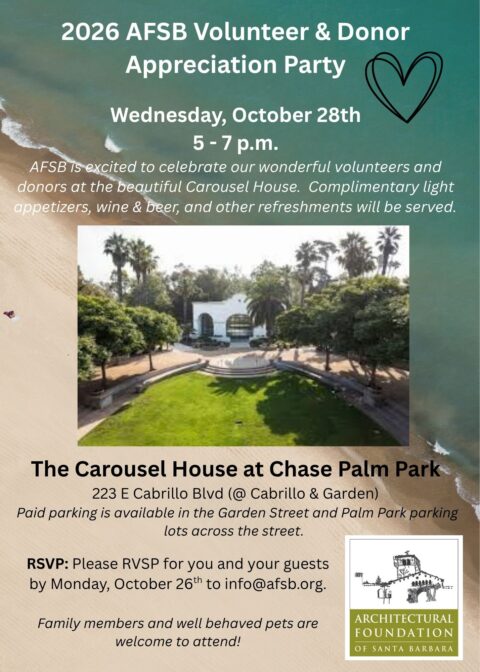
Wednesday, October 28, 2026, 5 – 7 p.m., The Carousel House at Chase Palm Park. Attention all AFSB Volunteers & Donors! Please join us for a party in your honor. Complimentary refreshments will be served. Partners, family members and well behaved pets are welcome to attend! Please RSVP to info@afsb.org by October 26th.
Spanish Colonial Revival Homes: Santa Barbara’s Signature Style
May 28: Betsy J. Green – Discover Your Home’s History
Spring 2026 Lecture Series
Register for this event here. (Suggested donation $20).
Being keenly aware of Santa Barbara’s built environment, especially the unique expression of each structure, is like unraveling a mysterious treasure hunt or jigsaw puzzle. Santa Barbara’s story is in large part told by uncovering the fascinating details of each structure and home that forms the city’s neighborhoods and overall character. Knowing your home’s history can even help attract prospective buyers and make your house stand out.
From reviewing old phonebooks, maps and building permits, to exploring genealogy websites, local historian, Betsy Green, will share “tips and tricks” for becoming your own house detective.
“There’s more and more information available online all the time – it’s a great time to be a home history hunter!” says Betsy.
Audience members are invited to bring questions about their home for Betsy to tackle in real time. Betsy will also share links to websites with useful information.
Betsy J. Green is a writer, local history aficionado, and author of the Great House Detective column for the Santa Barbara Independent.
May 21: Cheri Rae – Santa Barbara’s 1960s Highrise Battle
Spring 2026 Lecture Series
Register for this event here. (Suggested donation $20).
What would Pearl Chase do now?
Please join us for a lively discussion about how balanced housing development was achieved in the 1960s and can inspire ways to move forward today in a Santa Barbara way.
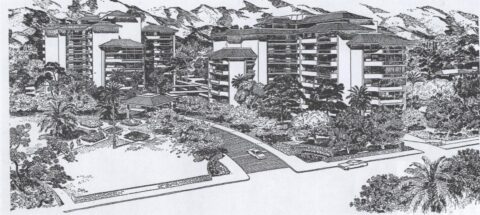
Back in the late 1960s, a 9-story 107-foot, two-tower condominium project along the El Mirasol block was proposed – and approved by Santa Barbara City Council – that would have changed Santa Barbara forever.
Thankfully, Pearl Chase was the leader of the Santa Barbara community activists who organized, raised funds, and successfully sued the City to prevent the outsized proposal.
The positive impact of that grassroots campaign led to a ballot measure that instituted height limits in Santa Barbara, and the site for the proposed towers became Alice Keck Park Memorial Garden, a lush garden with walking paths, benches, gazebo and pond, often referred to as the “crown jewel” of Santa Barbara’s city parks.
That was what Pearl did then to “Save Our City.”
But what would Pearl do now? And how do we follow in her footsteps?
Today, we are faced with similar issues of overdevelopment and can learn from the experience of the past. Recently enacted California housing laws streamline development by limiting local discretion, reducing community input, and enabling taller, denser projects near transit. By limiting local control, these measures are enabling developers to propose out-of-scale projects (in areas not designated for the scale), which is causing great community concern.
Cheri Rae will discuss the 1960s era Save Our City community initiative “to keep Santa Barbara Santa Barbara,” followed by an audience Q&A and refreshments on the patio.
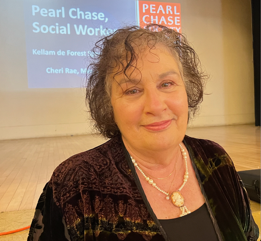
Cheri Rae is an ardent civic activist, award-winning columnist, and author of more than 300 articles and commentaries about Santa Barbara. “Channeling her inner Pearl,” Cheri has led efforts to preserve the city’s Bungalow Haven Neighborhood, historic buildings and trees. She is the author of the biography, “A String of Pearls: Pearl Chase of Santa Barbara.”
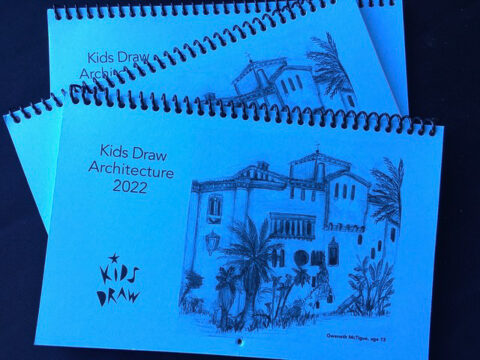
Kids Draw Architecture 2022 / Niños Dibujan Arquitectura 2022
Kids Draw Architecture Sketch Session at the Courthouse is back!
Join us on May 1st from 1-3pm at the Santa Barbara Courthouse on 1100 Anacapa Street to draw with local architects and artists, materials provided! We will also be accepting mailed in drawings of the Santa Barbara Courthouse through May 27th, 2022, more information below.
Exhibition – ATTENTION TO LOSS by Pecos Pryor
January 7 - March 5, 2022
January 7 – March 5, 2022. The Architectural Foundation of Santa Barbara is pleased to present Attention to Loss, an exhibition of drawing, printmaking, and sculpture by Pecos Pryor. Attention to Loss is Pryor’s debut one person show in Santa Barbara, CA.
Attention to Loss is a response to the question: “What do we do with our hands in grief?” In 2019 Pryor lost a family member to suicide, a family member to drug overdose, and went through a divorce.
Pryor comments: ” The art produced in this time has been physical, contemplative, full of mad and sad tears as well as loving ones. I have created traffic cones built from clay, concrete and fiberglass, and carved from wood, stone and plaster; drawings of single unmade beds; self portraits; woodcuts, etchings and mono prints derived from the imagery of sculptures and shadows; and monotonously colored full sheets of paper, dark space-no answers, but some color. With the inability to change tragedy, art making gives me something to do with my hands.”
“Attention to Loss is about looking at the darkness and demanding something be given back. What that something is, is yet unsayable.”
Pecos Pryor earned his MFA in Printmaking from the University of Nebraska-Lincoln and currently resides in Carpinteria, CA. He teaches Sculpture and 2D Design for Westmont College and Printmaking at Santa Barbara City College School of Extended Learning. Significant honors include the Francis William Vreeland Award in Art for 2018 and the Wendy Jane Bantam Graduate Exhibition Award. Attention to Loss is Pryor’s debut one person show in Santa Barbara, CA.
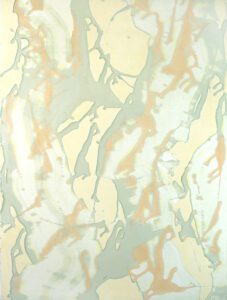
Images shown:
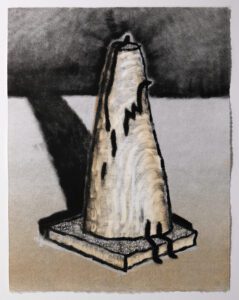
After the Memorial: Cone 2020 monoprint on BFK paper.
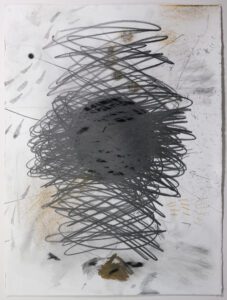
Untitleable 2021 graphite, conte crayon, metallic crayon, pen, knife marks, fingernail scratches on BFK paper.
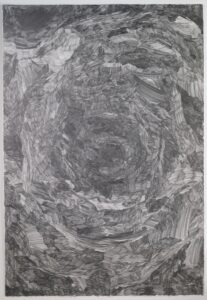
Medium Dark Gray: Colored Paper 2021, graphite on BFK paper
Exhibition – LOCAL TREASURES by Local Artists
September 18th - November 12th 2021
The Architectural Foundation of Santa Barbara is pleased to present Local Treasures, an exhibition of artworks by thirty artists who have exhibited at the Architectural Foundation Gallery during the past seven years. The exhibition runs from Saturday, September 18th through November 12th, 2021.
Local Treasures honors the extraordinary quality, diversity, and vitality of the artists whose work has recently graced the walls of the Architectural Foundation Gallery. Initiated during the 1990s, the Gallery exhibited watercolor paintings by local architects of Santa Barbara buildings. Later, the Gallery committee expanded its mission to present exhibitions of contemporary art, architecture, and design. Throughout the pandemic, following all COVID-19 protocols, the Gallery has maintained its schedule of exhibitions with the support of dedicated volunteers.
The Architectural Foundation of Santa Barbara has been dedicated to expanding our community’s appreciation of the built environment since 1983. The AFSB Gallery is located in the historic Acheson House at the corner of Garden and East Victoria Streets in Santa Barbara. Regular gallery hours are Saturdays from 1:00 to 4:00 pm and weekdays by appointment.
The exhibition will be installed in a celebratory salon style (works of different sizes and media will hang next to and above each another), creating dynamic groupings on the Gallery’s walls. Two-dimensional work including an abstract print by Tony Askew, a collage by Dug Uyesaka, and plein air paintings by Libby Smith and Nina Ward will be complemented by several reliefs—a surreal box construction by Michael Long and a geometric structure in styrene by Marilyn Helsenrott-Hochhauser. A weaving by Minga Opazo and a screen print by Claudia Borfiga will join photographs by Sara Yerkes, Jeffrey Sippress, Pat McGinnis and Matt Straka, as well as a sewn paper composition by architect Cass Ensberg and a hard-edge, environmental painting by Cynthia Martin. Two husband/wife duos—printmakers Siu and Don Zimmerman and painters Judy and Warner Nienow will also be featured.
Dancing With Paint by Marlene Struss
July 17 - Sept 8, 2021
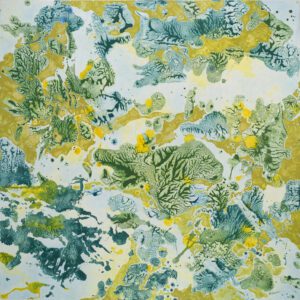
The Architectural Foundation of Santa Barbara is pleased to present Dancing with Paint, an intriguing exhibition of new paintings by long-time Santa Barbara artist Marlene Struss.
The title, Dancing with Paint, contains multiple references. It conjures the sloshing, swirling, elegant movements of Struss’s painting style, which she describes as biomorphic abstract expressionism with an Asian twist. On another level, Dancing with Paint characterizes Struss’s partnership with her paintings—how the organic, structural images quickly and almost magically emerge as the artist’s hand and the paint respond to each other in bursts of coordinated, exhilarated movements. “To prepare for those special moments of focused inspiration,” says Struss, “I spend much time and deliberation on my choices of harmonious colors, paint viscosity and unusual applicators (including yarn, balloons, plastic forks, acetate, rags, you name it)—but it’s dancing around the studio that really primes me and seems to be an essential part of my painting process.”
Marlene Struss graduated from UC Santa Barbara in 1973, where she studied drawing with Howard Warshaw, painting with Irma Cavat, and printmaking with Bruce McCurdy. She subsequently spent many years developing a unique style of abstract collage, for which she was awarded the Independent Artist Award for Assemblage in 2004 from the Santa Barbara Arts Fund. After a brief but significant stint with digital painting, she then turned to acrylic painting on panel to increase spontaneity and decrease limitations, to enliven the work with surface texture, and work more physically. More information and past and present artworks by Struss can be seen at www.marlenestruss.com.
The Architectural Foundation of Santa Barbara has been dedicated to expanding our community’s appreciation of the built environment since 1983. The AFSB Gallery is located in the historic Acheson House at the corner of Garden and East Victoria Streets in Santa Barbara. Regular gallery hours are Saturdays from 1:00 to 4:00 pm and weekdays by appointment.
‘Museum’ on West Valerio
'Museum' on West Valerio
Renovated Home is a Blast from the Past
By: Betsy J. Green
Address: 230 West Valerio Street
Originally Published in The Santa Barbara Independent
Link to original article here: https://www.independent.com/2021/10/21/museum-on-west-valerio/
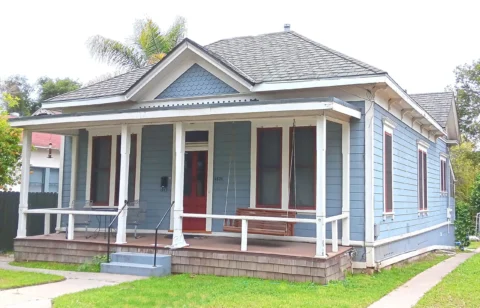
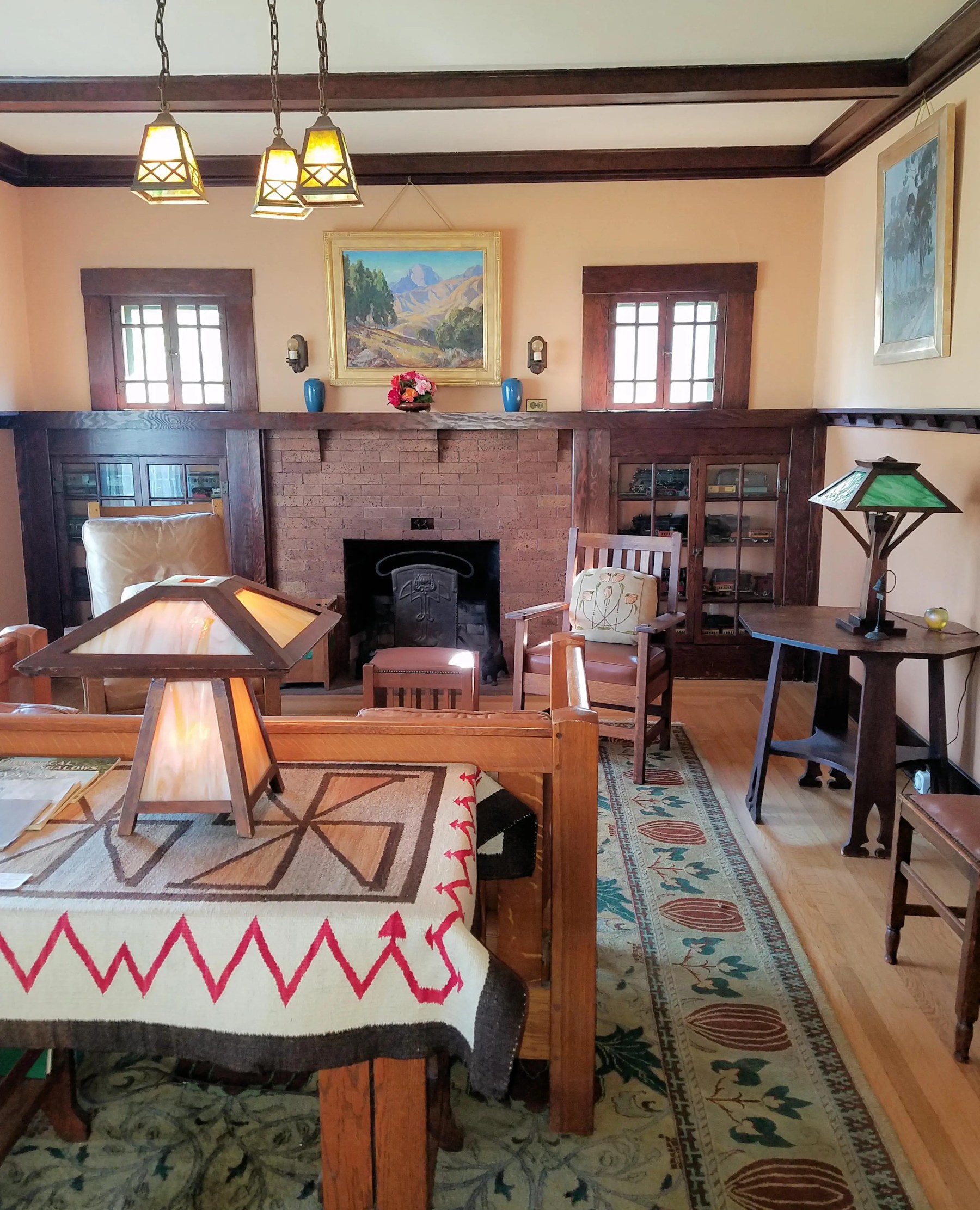
Only a dozen or so homes in Santa Barbara have been featured in Old House Journal magazine. This is one of them. Walking into the home is like walking back in time. The furniture and décor echo the Craftsman bungalow style that was popular a century ago. This home was built in 1912 for $1,500. The owners, Robert Sponsel and Patricia Chidlaw, joke that some of their renovations cost more than that. They call the home “our museum.”
The home’s exterior colors and plantings blend smoothly with the style. A 1914 paint catalog noted, “The bungalow is distinctively a suburban house … to make it attractive, the colors as well as the architecture must harmonize with nature.” The risers on the front steps are decorated with a vine called creeping fig (Ficus pumila) that also grows on the famous Gamble House in Pasadena.
One of the most eye-catching items in the kitchen is a 1930s GE refrigerator. These appliances were commonly nicknamed “monitor” refrigerators because the round compressor on top resembled the gun turret on the USS Monitor, an ironclad Civil War vessel.
Credit: Betsy J. Green
Good News, Bad News
Imagine picking up the morning paper and reading your own obituary! That’s what happened to E.J. Peterson, the home’s first owner. The obit used his name but described the life and death of another S.B. resident named E.J. Hayward, a well-known photographer.
I suppose that the good news about reading his own obituary notice is that he was able to contact the paper and get a correction printed the next day. The paper called it “an unfortunate mix-up,” and added that “Mr. Peterson … is very much alive and the mix-up in names kept Mr. Peterson denying that he was even ill.”
One of the home’s most interesting owners was Henry Augustus Adrian and his wife, Phila, who owned the home in the early 1920s. Adrian had served as the superintendent of schools and was the mayor of Santa Barbara in 1926 and 1927. In addition to these careers, Adrian often traveled the country as a speaker in Chautauqua assemblies. The Chautauquas were a sort of continuing education for adults that traveled from town to town. The practice began in Chautauqua (chuh-TAW-kwah), New York, in 1874. Generally, the group would set up a tent in a town and present a weeklong series of educational lectures and performances. Adrian was a friend of the botanist Luther Burbank and spoke about his plant research.
Another interesting owner was F.H. Kimball and his wife, Charlotte. Kimball was the president of the Veronica Medicinal Springs Water Company. This was a mineral spring located near Veronica Springs and Las Positas roads.
Hard Work and Luck
Here’s another example of good news and bad. When the present owners bought the house in 1980, it had been “modernized” in the 1960s by an owner who painted the woodwork white and ripped out the original cabinets. The good news was that he had taken “before and after” photos, which enabled Robert and Patricia to restore their home to its original appearance.
Apart from stripping paint, they had some lucky finds in their search for period-appropriate fixtures. Patricia happened to be walking the dog one day and found a beautiful claw-foot bathtub that had been discarded. Salvaged items from nearby demolitions also helped keep down the restoration costs.
What advice do they have for homeowners wishing to attempt similar retro decorating? “Bob and I were fortunate that we started looking in the early ’80s before the vogue for restoring Craftsman homes. You could still find inexpensive pieces in thrift stores and at yard sales. I guess my advice would be to study the books and familiarize oneself with the style and then look at resale situations and hope to get lucky. The Stickley furniture company is still in business and making beautiful reproductions of classic designs. While these are not cheap, I imagine they could be considered a good buy because the solid oak will certainly last more than a lifetime.”
Please do not disturb the residents of 230 West Valerio Street.
An Artistic Abode
An Artistic Adobe
Moving Story of this Sunny Home
By: Betsy J. Green
Address:1128 Bath Street
Originally Published in The Santa Barbara Independent
Link to original article here: https://www.independent.com/2021/09/30/an-artistic-abode/
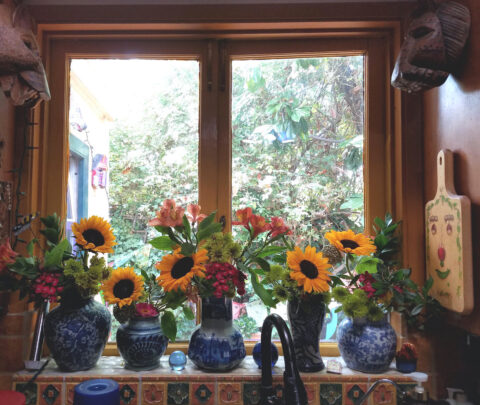
There’s no mistaking that an artist lives in this home decorated inside and out with artwork from Santa Barbara’s iconic Summer Solstice parades. It’s the domicile of Claudia Bratton, who has overseen the extravagant annual parade 16 times. The parade began in 1974 as a sally up State Street as a birthday celebration. It has since morphed into a procession of funky and fantastic floats, dancers, and stilt-walkers, ending with an inflatable one-ring circus and drawing thousands of visitors to our sunny streets.
The home’s first owners were Joshua Snell and his wife, Anna B. They had farmed in Montecito and Carpinteria before moving to Santa Barbara. Joshua bought the land on the corner of Bath and Anapamu streets in 1886, and he probably built the home at that time. The original building permit stated that the house cost $1,500. Like many homes — including the one that I wrote about in last month’s column — this home has had a change of address. Although unlike that one, this house was actually moved.
Snell was originally from Maine and may have participated in the annual picnic for former Maine residents in Santa Barbara, some of whom called themselves “Maniacs.” He had been an investor in an ostrich farm on State and Islay streets about 1909. At the turn of the century, ostriches supplied feathers for women’s hats.
A Moving Experience
The home was originally located on Anapamu Street. Around 1910, the Snells moved it to the back of their property and turned it to face Bath Street. There is no building permit on file for moving the house, but perhaps permitting wasn’t necessary if you were moving a house from one part of your property to another at that time.
How many houses have been moved in Santa Barbara? Who knows, but a 1922 article that I found in the local paper stated that 33 homes had been moved that year. Occasionally, people even moved homes that did not belong to them. In 1915, a man moved a home from one side of Milpas to the other — without the owner’s permission.
Homes and buildings were moved in a couple of ways. Generally, several holes were punched in the foundation in either side of the home, and beams or logs were put through the holes under the subfloor. The remainder of the foundation was then removed. For a simple move, the house was dragged along on the logs by oxen, horses, or mules.
For a more high-tech house move, the beams under the house were raised up with gigantic jackscrews, and a truck bed was placed under the house. Draft animals or motorized vehicles pulled the house. It was a slow process and might take days.
In 1906, a house moving here outraged multiple citizens, “Before this house reaches its destination [30 blocks away] the injury it has wrought on the shade trees, the inconvenience it has caused, and the property rights it has outraged” caused people to petition the city council to place a limit on the size of homes moved around.
Attention to Details
Varied Occupations
There has been an interesting assortment of owners of this home. Walter A. Scott was part owner of a livery stable, which rented horses and carriages. Emma Harris, another owner, sold corsets. Her ad in 1915 stated that she had “scores of delighted patrons in Santa Barbara.” Corset wearers were sometimes nicknamed “old ironsides” because some corsets were reinforced with steel or iron rods.
Another homeowner — Cora Loretta Dowhower — owned an art shop along the Street in Spain in the El Paseo building. Her neighbors there included artists Ed Borein and Clarence Mattei. Dowhower was also a charter member of the Santa Barbara Business and Professional Women’s organization.
Not only is the house decorated with artwork, but it is also nestled in a lush garden. Bratton is not sure why her garden grows so well, but maybe the home’s history provides a clue. I found an ad in the local paper in 1914 in which the homeowner was selling chickens. Perhaps the chickens’ — ahem — “contributions” enriched the soil.
Please do not disturb the residents of 1128 Bath Street.